Covalent Bond and Metallic Bond | My Journey In Science 4

Today, we continued discussing about Covalent Bond and also we discussed some of the topics from Metallic Bond.
But first, let me share you how I understand the Ionic and Covalent Bond easily with these examples. Let’s look at the following two scenarios A and B. There are two kids, Emily and Sarah. They both are very good friends.
Scenario A
IONIC BOND - TRANSFER

Scenario B
COVALENT BOND - SHARE
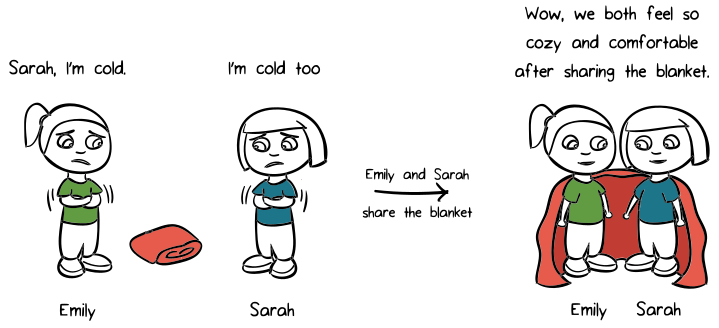
Now let’s apply the above analogy to chemical bonding. Assume that Emily and Sarah represent two atoms, and the blanket symbolizes their valence electrons. In scenario A, atom Emily is willing to donate her electrons (blanket) to atom Sarah because by doing so both achieve an octet configuration of 8 electrons in their respective outer shells, making them both happy and stable. This donation of electrons is called ionic bonding.
Example of an ionic bond

In scenario B, both the atoms Emily and Sarah are equally electronegative. So, neither Emily nor Sarah is ready to part with her electrons (blanket), and they instead share their valence electrons with each other. This is called a covalent bond. Electronegativity is a measure of how strongly an atom attracts electrons from another atom in a chemical bond and this value is governed by where the particular atom is located in the periodic table (francium is the least electronegative element while fluorine is the most electronegative).
Example of a covalent bond
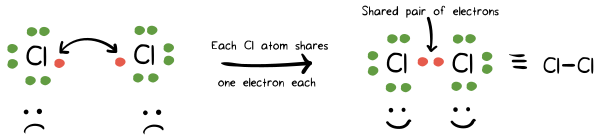
I hope this helped you to understand more what's the difference between Ionic and Covalent Bond.
To name covalent or molecular compounds, nonmetal must be the first one to name, while the second nonmetal is named by changing its suffix wide -ide. Using prefix such as mono, di, tri, etc. at the beginning of each element to indicate he number of atoms presented in the element. We do not use the mono in the first element of the formula to avoid uncomfortable pronunciation.
MOLECULAR GEOMETRY
As we tackled he lesson about the Lewis Electron Dot Structure from Ionic Bond which helped us to tell how the atoms in molecules are bonded to each other. But, the topic didn't tell told us the shapes of the molecules. Well the Molecular Geometry will give us the general shape of the molecules. The shape depends on the number of bonding pairs present around the central atom and how many of those bonding pairs are participating in a bond.
There are five types of Molecular Shapes, we have the linear, Trigonal Planar, Tetrahedron, Trigonal Bipyramid, and the Octahedron.

Examples of each shapes:
Linear - Carbon Dioxide (CO2)
Trigonal Planar - Boron Trifluoride (BF3)
Tetrahedron - Water (H2O)
Trigonal Bipyramid - Phosphorus Pentachloride (PCI5)
Octahedron - Sulfur hexafluoride (SF6)
METALLIC BONDS
We are now at the third and last type of bonds, the Metallic Bond. Just like the name of this bond, this type of bond is all about bond among metals. This bond is different from the previous bonds we have tackled. The Ionic and the Covalent Bonds. As metals lose their outer electrons, metal cation are formed.
One of the properties of metal is malleability, ductility, having a high melting point, and are good conductors of heat and electricity.
As we all know, malleability is the ability of metals to be shaped by pressure. While ductility is the ability of metals to be drawn into a wire.
We're not having a quote for today but here's a cute explanation about the three types of bonds! :)

I hope you got something from this blog. Thanks for reading.
Credits to Khanacademy for the picture I used in the scenarios.


Comments
Post a Comment