Ionic Bonds and Covalent Bond | My Journey In Science 4

Today we continue discussing Ionic Bond, Lewis Electron Dot Structure or LEDS, Ionic Charges, Formation Of Ionic Compounds, Writing Chemical Formula, Naming Binary and Ternary Compounds, Important Ions and ionic Compounds, and Formation of Covalent Compounds.
Lewis Electron Dot Structure give special importance to the atom's valence electrons and this is a shorthand method which consists of a symbol of the element surrounded by dots. The dot represent the valence electrons of the atom; while the symbol represents the nucleus of the atom. LEDS was proposed by Gilbert N. Lewis.
To draw the Lewis Electron Dot Structure here are the steps that I got from our book. Let us use the Nitrogen atom (N) as an example.

Step 1: Write the chemical symbol of the atom.
Nitrogen's chemical symbol is N.
Step 2: Determine the column or group where an atom belongs in the periodic table or write down its electron configuration to find out the atom's number of valence electrons. For representative elements, the number of valence electron is the same as the atom's group number or column.
Nitrogen, a representative element, belongs to Group 5A; therefore, its number of valence electrons is 5.
Nitrogen with 7 electrons has configuration of 1s22s22p3 . This reveals that carbon has 5 valence electrons.
Step 3: Draw the dots that will correspond to the number of he atom's valence electrons. Distribute the dots evenly, where it may be above or below and/or either side of the chemical symbol.
IONIC CHARGES
We all know that there is 118 known elements presented in the periodic table of elements. However, talking about the substances existing here on Earth, there are over 118 elements because elements react with one another forming new substances called compounds. A compound is different both in its physical and chemical aspects from the original atom or element to which it come from.

FORMATION OF IONIC COMPOUNDS
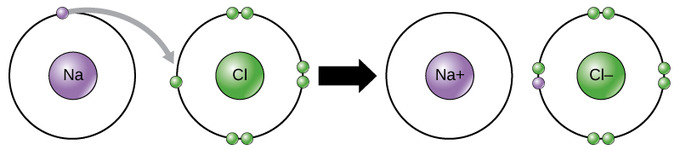
I learned that Ionic bonds are formed through the exchange of valence electrons between atoms, typically a metal and a nonmetal. The loss or gain of valence electrons allows ions to obey the octet rule and become more stable. Ionic compounds are typically neutral. Therefore, ions combine in ways that neutralize their charges.
WRITING CHEMICAL FORMULA
Compounds can be represented through a chemical formula. A chemical formula is a shorthand method in writing the name of the compound. It shows symbols to represent the elements and a subscript to represent the exact number of atoms used.

I learned that if the magnitude of charges has the same, you can just write the elements together.

And if the charges do not have the same, you can use the crisscross method. The crisscross method is done by writing the charge value of the first ion on subscript of the second ion and vice versa. After that, you will just distribute the charges of each elements.
Naming Binary and Ternary Compounds is simple. For Binary Compound, all you have to do is to change or name the cation first( specify the charge if any). Then name the anion changing its suffix to -ide. Meanwhile, to name ternary compounds, you just need to name the cation first, followed by the name of the polyatomic ion.
COVALENT BOND
When two or more nonmetallic elements combine in a covalent bonding, a molecule is formed. Gases like O2, H2, N2, F2, Cl2, Br2, and I2 always occur as diatomic molecule. As such,they are more stable than single atoms.
There are three types of covalent bond exist which depend on the number of shared electron pair. These are single covalent, double covalent, and triple covalent bond.

- Single Covalent Bond - denoted by one short line (-), is the sharing of one electron pair between two atoms.
- Double Covalent Bond - denoted by two short lines (=), is the sharing of two electron pairs.
- Triple Covalent Bond - denoted by three short lines (≡), is the sharing of three electron pairs.

And that's it for today. After our discussion, our teacher asked us to make a video of ourself telling what thing is reminding us the Christmas.


Comments
Post a Comment